
The bell rang, and I could see in the square aperture of the video screen a woman, black, in a gray coat, slightly staggering away from the door. The buzzer failed, and rather than wait for a second ring that never came, I walked down the passageway to open the door myself.
As they came in, the woman and her child, I could hear her repeatedly say to the child—a girl with long, newly placed braids—to fix her coat, to listen. Later in the program for the day, I overheard the woman say, “I’m trying to pass a pain that hurt me thirty-eight years ago.”
I thought about what she said for a moment. She’d been trying to ease a hurt nearly four decades old, and though she was likely unaware of doing it, she shared it in such a fashion as to reveal the source of her demeanor—her stagger.
Without nerves or anxiety, the elixir of her choosing granted her what? Less pain? Less remembrance? Solace? At the same time, just the opposite was offered to the young girl, her daughter, who was with her—a daughter who knew, likely, and would know, no end to daughtering. And then a family member of the woman, also present, shared that when she was like that, no one ever said what it was—but that when she was like that young, she, this woman, watched her own baby.
The woman, who would not give me her name—which I asked when I saw her lying prostrate on the front bench—was not bashful. At one point, she addressed me and asked, “You—not African—you from here?” I quickly responded that my family was from South and North Carolina. Momentarily I was pulled back to my younger years of being othered—years of being asked to verify my belonging here uptown, when the taunt was “African booty scratcher.” We, although together in that Harlem building, were likely all from the South, each trying to best the other in a search for normalcy amidst poverty, change, and the friction of family dynamics.
In the moment, I did not think of Sula. But in looking back at notes from reading Mecca Jamilah Sullivan’s The Poetics of Difference, I see that I jotted down words from Sullivan, quoting Janet Mock. Mock writes how she wishes she could be a woman like Morrison’s Sula—ok in her otherness, a woman with no pressure to verify herself (Sullivan, 194). Mock is responding here to having experienced a forced disclosure. Sullivan offers this experience as just one way readers reach for and into the “Black feminist literary interior.”
I have found and find myself reaching into that same interior, aspiring to be like Sula were if not for the watchful eye of my own community. As said in the book, Sula subverts their eye, turning toward her own aim: to be consistent with herself alone. Sometimes it is also the conventions of marriage, of which I stand in, which makes it even more difficult to be a woman “ok in her otherness.” What does that mean, OK? Comfortable? Sure. Enthusiastic? Maybe not. Satisfied? Possibly.
At the job, one of the things most people immediately notice is the murals painted on the inner walls. The murals act as a symbolic gateway to the work—transformative and brewing within the building. I think when I first interviewed there, I noticed the oversized slate doors at its entrance. Those doors lead to the passageway where murals—telling a story of community, seeding, ancestry—line the tall walls of the four-story building.
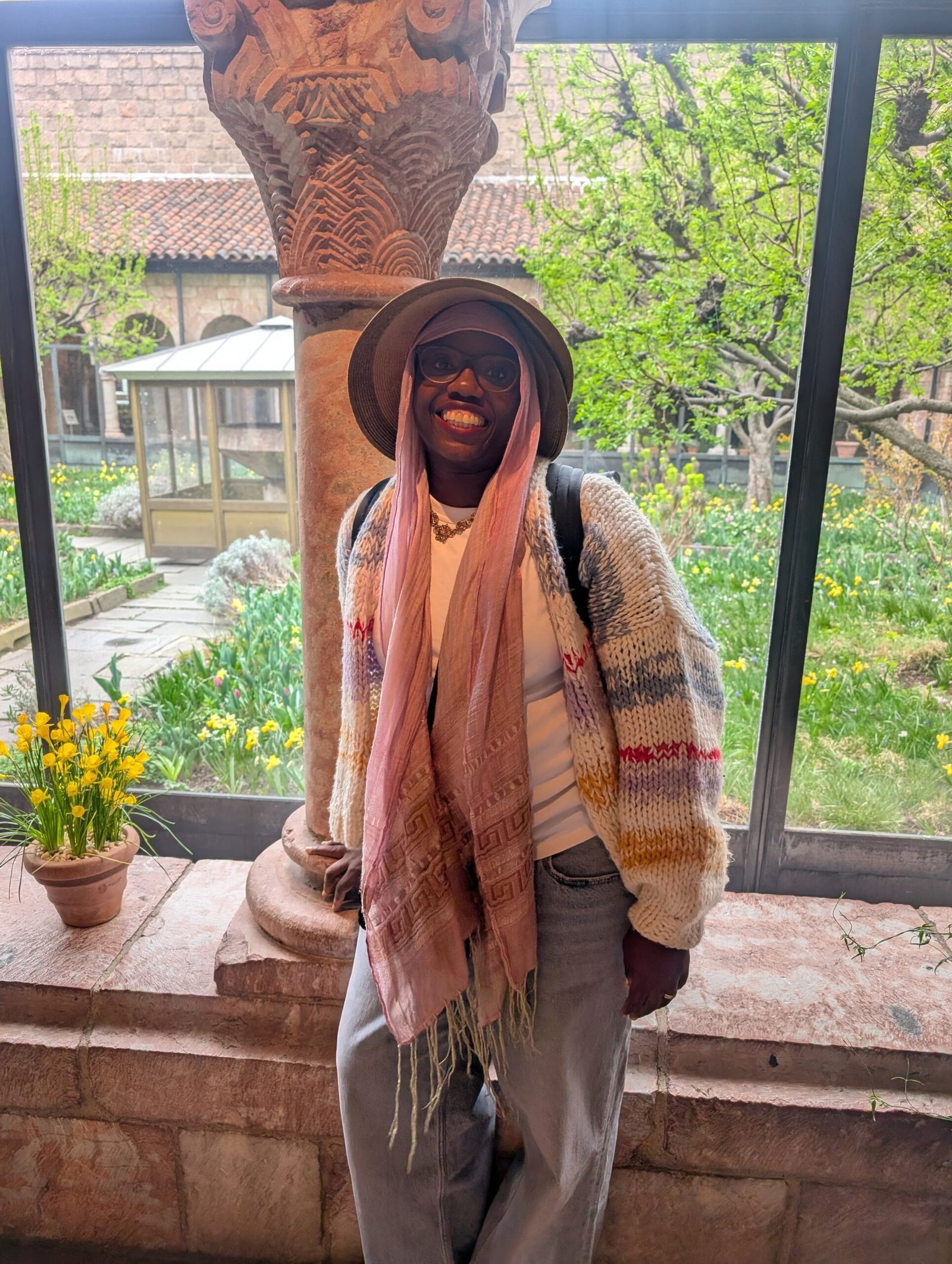
There is some stone throughout, though not a Gothic kind of chiseling, not detailed, not like the many archways found in The Cloisters, where we went recently to visit the museum there. We learned from the museum guide about the portals—the doors to the chapels—the work, almost feverish in nature, of George Grey Barnard to purchase Gothic medieval works of art and the cloisters themselves in the early 20th century.
The portals, designed with chisels, portraits of religious moments and stories, were seen as both a physical entryway and a symbolic gateway to heaven. They represented the threshold between the secular world and the sacred space within.
Mommy used to say her work as a midwife was a doorway—a passageway between the here and now, and the there and then.
I also left with a new set of waist beads—glow-in-the-dark, no less. I peeked over and saw another woman getting hers fitted, her belly exposed, her eyes dreamy. She was being cared for, attended to, waiting with the turn of her hip for her turn to be adorned.
May that we enter spaces delighted in our coming, auspicious in our going.
May that we adorn ourselves, our homes, as thresholds, as practice—
May that we be writ in light, may that we become.


Leave a Reply